Preventive maintenance is one of the key tools of facility management, directly influencing the lifespan of building systems, the operational reliability of buildings and the overall costs of their management. There are several types of maintenance – preventive, predictive and reactive. All of them are practical for use in a facility management context and offer guidance on how to effectively manage the maintenance of technology in modern buildings.
What is preventive maintenance?
Preventive maintenance is a planned set of activities carried out before a fault occurs. The aim is to keep equipment in a stable condition, detect wear and tear early, and manage risk.
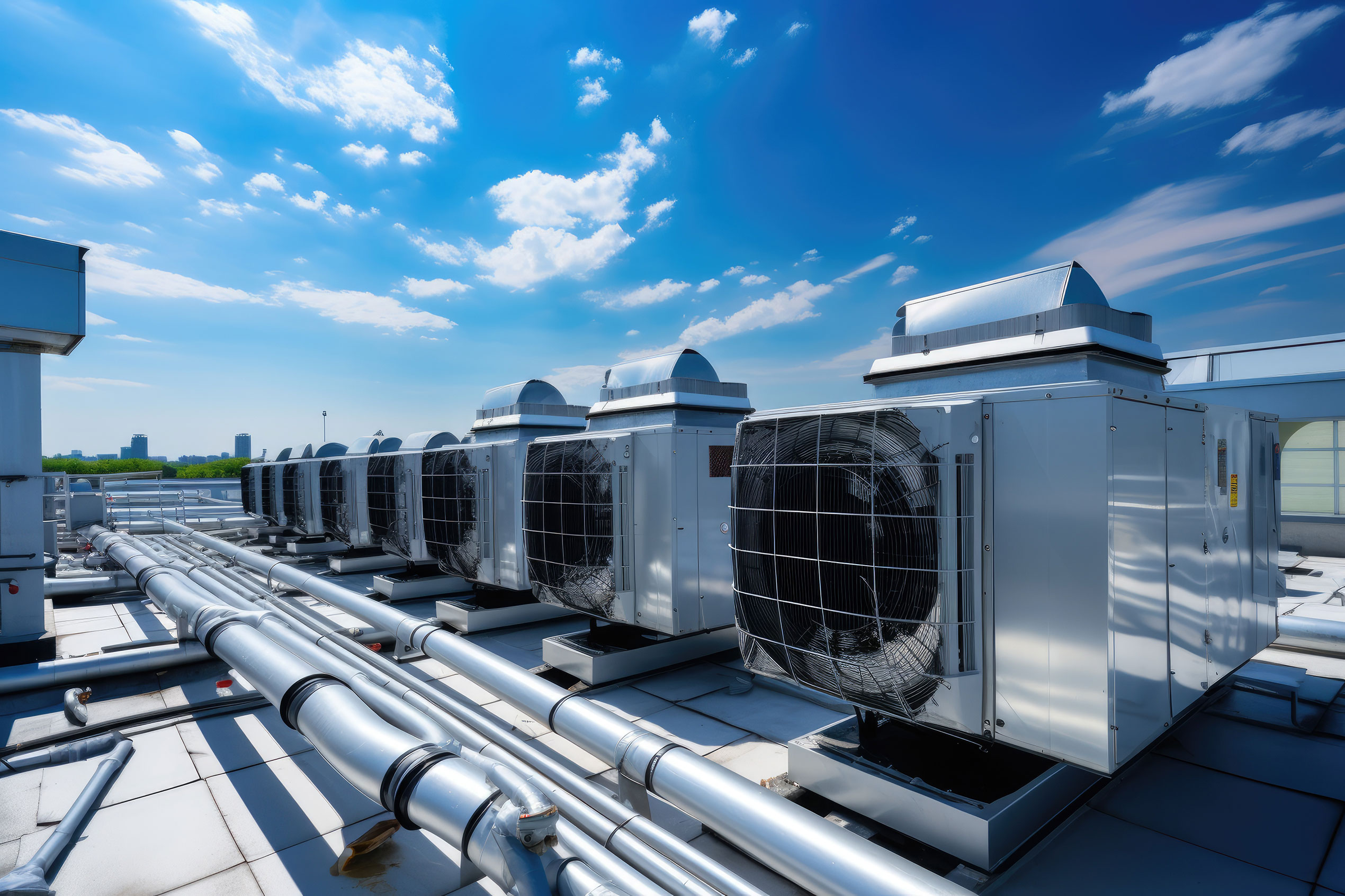
In a building environment, this typically involves regular and repeatable interventions on HVAC (cooling, ventilation, boiler rooms), electrical systems, lifts, UPS, fire safety and other systems. Technology maintenance primarily includes cleaning, replacements, inspections and calibration. It is crucial to understand their impact.
- Cleaning of equipment (e.g. filters, heat exchangers, fans, condensers) maintains flow rates and efficiency, reduces energy consumption and the risk of overheating.
- Replacing wear parts (belts, filters, seals, lubricants, bearings, UPS batteries) prevents sudden failures and increases operational reliability.
- Inspections (functional tests, visual inspections, safety tests, current/insulation measurements) detect anomalies before they turn into a breakdown.
- Calibration of measuring and control elements (temperature/CO₂ sensors, flow meters, pressure sensors, energy meters) ensures that the control system does not ‘operate based on incorrect data’, which has a direct impact on comfort and costs.
Preventive maintenance is most often guided by two principles:
- Time-based maintenance – Interventions at fixed intervals (monthly/quarterly/annually). Particularly suitable where there are fixed checks and inspections (legislation, safety features) and for equipment where wear and tear can be reliably estimated based on time.
- Operations-based maintenance – Interventions based on actual usage (operating hours, number of starts, air volume, load). Suitable for technologies with variable operation, where a ‘calendar’ schedule does not reflect reality.
The opposite approach is the reactive (breakdown) approach. You only deal with what breaks down. In the short term, this may seem cheaper, but in buildings it typically leads to more expensive interventions (emergency call-outs, damage from subsequent faults), a higher risk of downtime and faster ageing of equipment – in other words, a higher TCO. In facility management practice, the aim is therefore to shift from firefighting to planning – to stabilise operations through preventive maintenance, and to gradually introduce elements of predictive maintenance for critical equipment.

What is predictive maintenance?
Predictive maintenance (PdM) is based on a simple idea: the equipment continuously tells you what condition it is in, and you intervene when it is really needed – not too soon (unnecessary costs), nor too late (failure). Whilst preventive maintenance works with intervals and checklists, predictive maintenance works with data, trends and thresholds. It is typically deployed where a breakdown has a significant impact (comfort, safety, production), where the costs of a breakdown are substantial, or where the equipment is difficult to access and servicing must be planned.
In practice, several types of diagnostics and data collection are most often combined:
- IoT sensors and online monitoring: Sensors (temperature, pressure, humidity, current/voltage, filter differential pressure, flow rates, vibration) are installed on equipment or in switchboards. Data is sent at short intervals to a platform where trends, deviations and alarms are monitored. The benefit is that, instead of ‘intuitive’ maintenance, you receive an objective signal of performance degradation (e.g. gradual clogging of filters or heat exchangers), and you plan interventions based on reality, not on a calendar.
- Vibration measurement (vibration diagnostics): In rotating equipment (fans, pumps, compressors, generators), vibrations are one of the most sensitive indicators of a mechanical problem. Changes in the spectrum, increases in amplitude or typical ‘signatures’ of imbalance and bearing damage are monitored. Thanks to this, you can often detect a fault weeks or even months before failure and address it within a planned maintenance window.

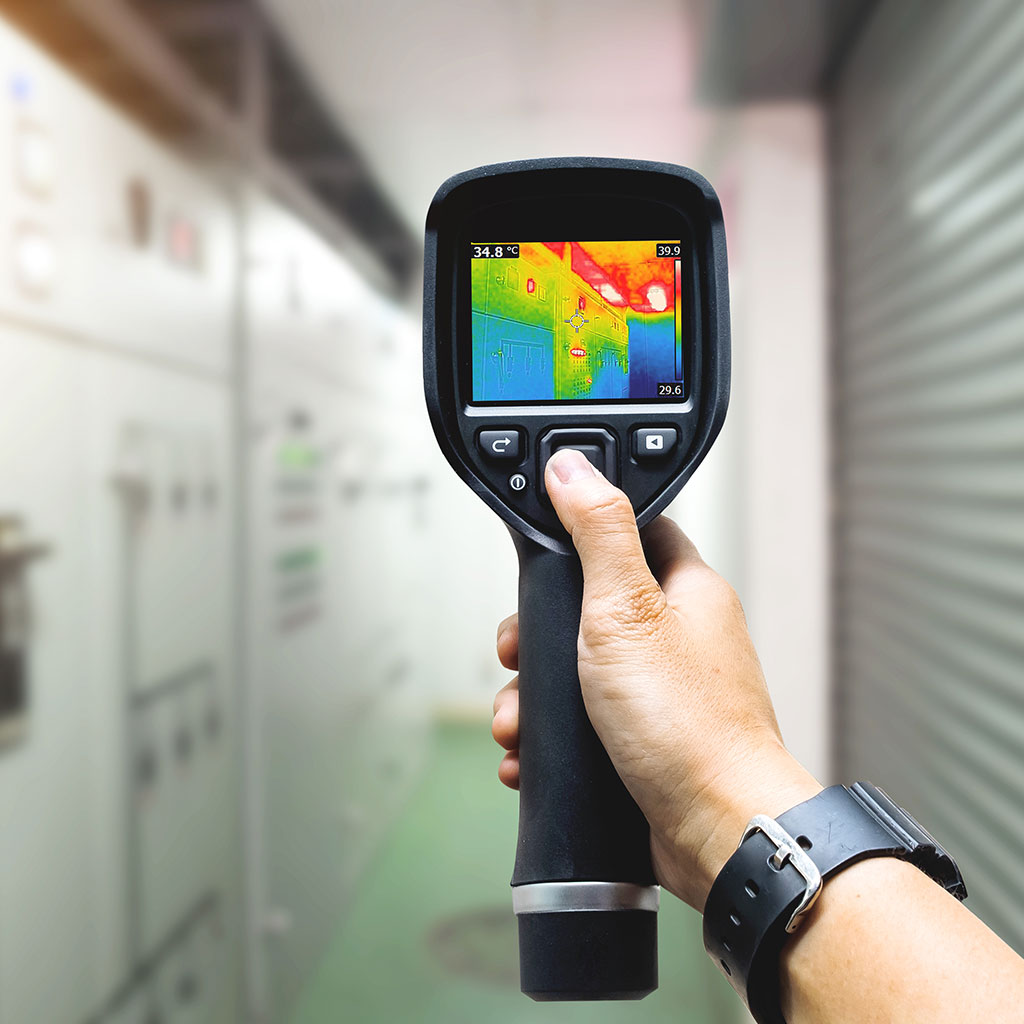
- Thermography: A thermal imaging camera detects overheating of connections, uneven phase loading, loose terminals, contact resistance or localised heat loss. In buildings, thermography is useful for switchboards, UPS systems, server rooms, power supply routes and certain parts of HVAC systems. The benefit lies in preventing fire risks and outages caused by overheating – often without the need for downtime.
- Data analysis and models: Raw data alone is not enough. It is the interpretation that adds value. In a simpler mode, this involves threshold values and trend analysis (e.g. increasing current draw under the same load); in a more advanced mode, it involves correlations and fault prediction models (e.g. estimating the remaining service life of components). As a result, instead of one-off ‘snapshots’, you gain a management tool and can target interventions only at equipment that is actually deteriorating.
Predictive maintenance – the data lifecycle
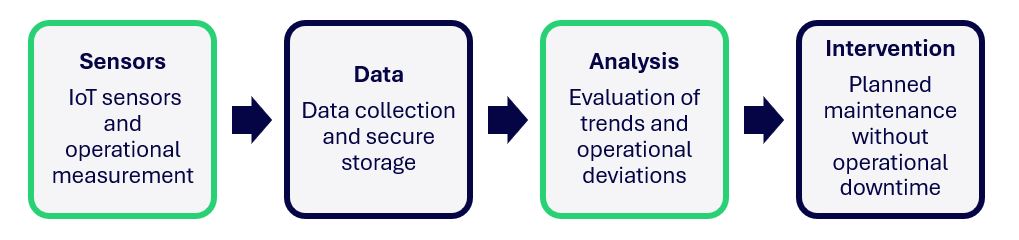
For predictive maintenance to work in a facility environment, it must be integrated into the process: who receives the alarm, who evaluates it, how a work order is generated, and how the result is fed back into the records. That is why, within the context of process digitalisation, predictive maintenance is typically integrated with CMMS (work orders, history, costs) and, ideally, with BMS (operational data, alarms, context).